BNC Connector
push, twist and lockThe BNC connector keeps a coaxial cable’s centre conductor and shield aligned through a two-lug bayonet coupling. Push and turn the collar to make a fast, repeatable connection without threads.
BNC describes the mechanical family—not the whole electrical specification. Match impedance, frequency rating and cable as well as the plug.
Anatomy of the connector
Use the supplied plate to identify the connector, then check the four details below before selecting, terminating or mating it.
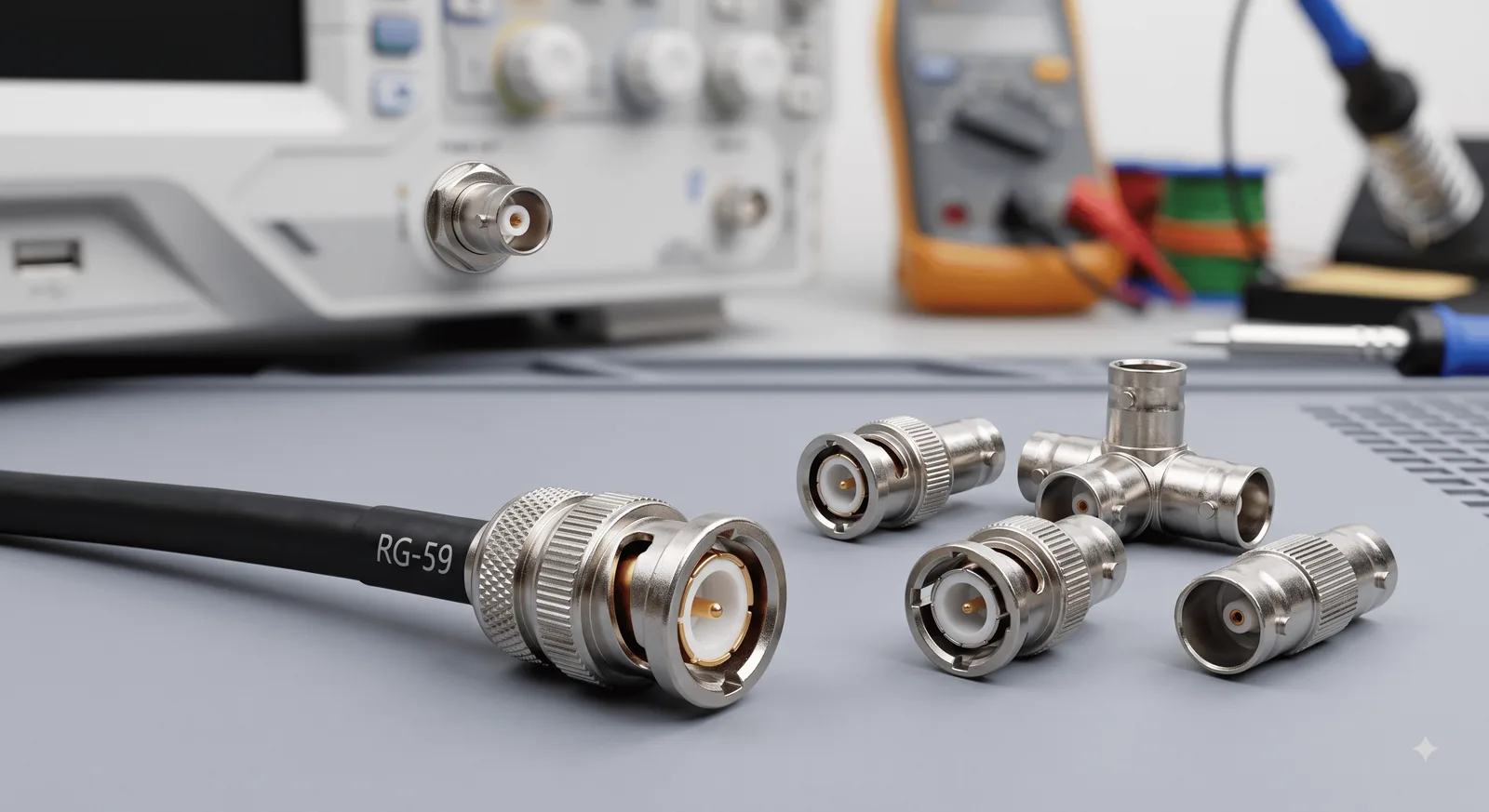
Four details to check before connection
The pin or socket carries the signal conductor along the connector axis.
Insulation holds the centre contact in position and maintains impedance.
The metal shell continues the cable shield and return path.
Slots engage two posts on the receptacle and lock with a short twist.
Where it is used
The connector body is only one part of a link. Cable type, signal, impedance or optical polish must match the equipment on both ends.
Oscilloscopes, generators and RF benches use BNC for rapid connection changes.
75-ohm BNC remains common on professional and legacy baseband video equipment.
50-ohm versions connect antennas and lower-frequency RF equipment.
In cybersecurity & operations
BNC is easy to disconnect, split and adapt. Protect exposed panels and confirm that every component preserves the intended impedance and signal path.
A 50-ohm and 75-ohm BNC may mate physically but cause reflections and signal loss.
Inspect for splitters and adapters that could tap or incorrectly terminate a shared coax path.
A half-turned collar can create intermittent faults. Verify both lugs are engaged.
Some buses and test setups require a correct terminator at the final port.