Fiber Optic Cable
light guided through glassFiber optic cable turns bits into pulses of light and guides them through an ultrapure glass core. Because no electrical signal crosses the link, fiber delivers high capacity over long distances and is immune to electromagnetic interference.
Fiber carries data as light confined inside a glass core—fast, long-reaching and electrically isolated from end to end.
Anatomy of the cable
Read the supplied diagram first, then follow the four layers below from the signal path out to the protective jacket and termination.
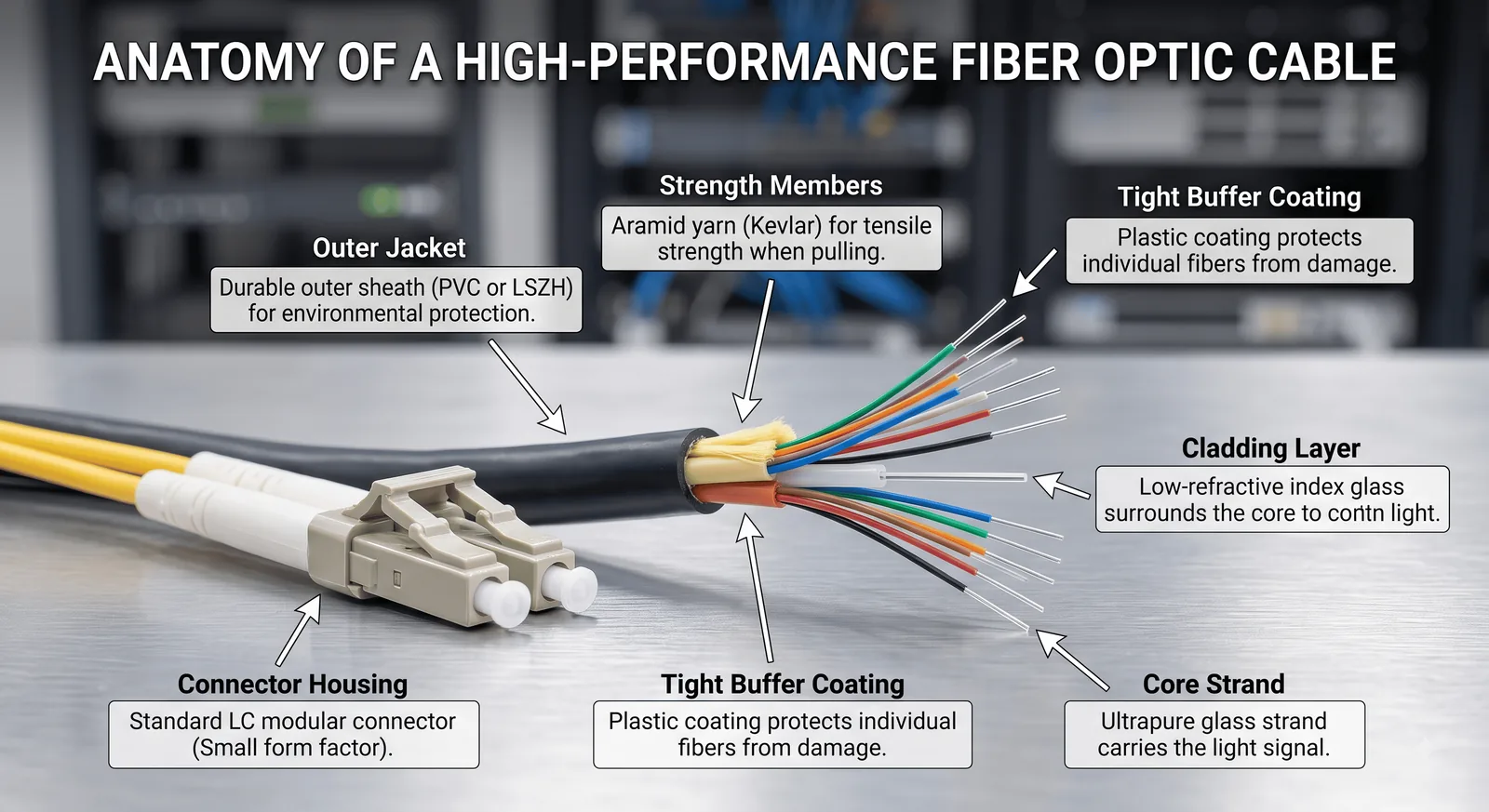
The four parts that make the medium work
Ultrapure glass carries the light. Single-mode uses a very small core; multimode uses a wider one.
Glass with a lower refractive index surrounds the core and keeps light guided along the path.
Coatings and aramid yarn protect the fragile glass from moisture, crushing and pull tension.
The outer sheath suits the environment, while a clean, correctly polished connector aligns the cores.
Where it is used
The cable name is a family, not one universal specification. Pick the construction, connector and equipment for the actual link.
OS1/OS2 fiber and laser optics serve campus, metro, provider and long-distance links.
OM3/OM4 fiber supports short, high-speed links inside buildings and equipment rooms.
Fiber crosses noisy industrial areas and links buildings without carrying ground potential or lightning current.
In cybersecurity
Fiber does not radiate like copper and is harder to tap without disturbance, but it is not magically secure. Protect the path and encrypt sensitive traffic end to end.
A tight bend or physical cut can degrade or stop a link. Secure trays, ducts, handholes and patch panels.
Specialised couplers can siphon light. Monitor unexpected loss and keep critical paths physically controlled.
Dust on an end face causes loss and reflection. Inspect and clean before every mating.
Wrong optics or excessive received power can damage equipment. Match wavelength, reach and link budget.
Two logical links in the same conduit share one failure. Use physically diverse paths where resilience matters.
Fiber protects the medium, not the data. MACsec, IPsec or application encryption protects the payload.