Hub
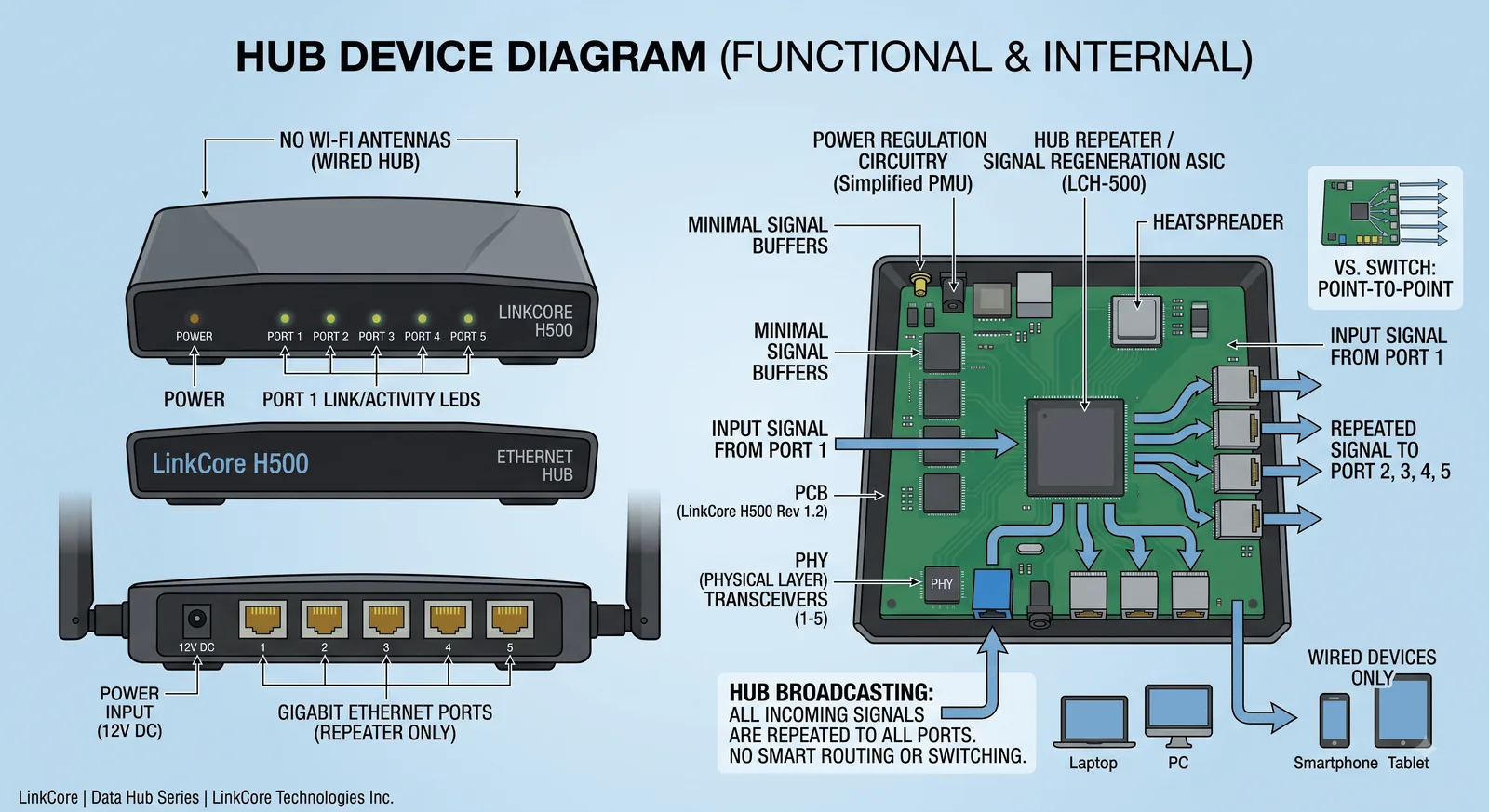
the Ethernet hubA hub is the simplest way to join computers: it repeats every bit it receives out of every other port. It makes no decisions, reads no addresses, and puts every host on one shared segment — the switch’s obsolete ancestor.
A hub copies every signal to every port — so all devices share one collision domain.
How it works
to every port
A hub can’t tell devices apart, so one host talking means every other port receives it — and if two talk at once their signals collide and both must resend.
What a hub does, step by step
An incoming signal arrives on one of the ports.
It cleans and repeats the raw electrical signal — no framing, no addresses.
The same signal goes out of all the other ports simultaneously.
If two hosts send at once the signals corrupt; CSMA/CD makes both back off and retry.
In cybersecurity
Because every port sees every frame, a hub has no privacy and is a sniffer’s dream.
Any port can read all traffic on the segment — no effort required.
Everyone shares one broadcast and collision domain.
The shared segment is easy to flood or jam.
Nothing authenticates a device before it joins.
Switches fix every one of these problems.
A forgotten hub is a ready-made covert tap point.