Coaxial Cable
one conductor inside anotherCoaxial cable carries an electrical signal along a single centre conductor while a concentric shield provides the return path and blocks interference. The dielectric between them keeps the spacing—and therefore the impedance—predictable.
Coax works because its signal and shield share the same axis—a controlled path that keeps radio-frequency energy in and outside noise out.
Anatomy of the cable
Read the supplied diagram first, then follow the four layers below from the signal path out to the protective jacket and termination.
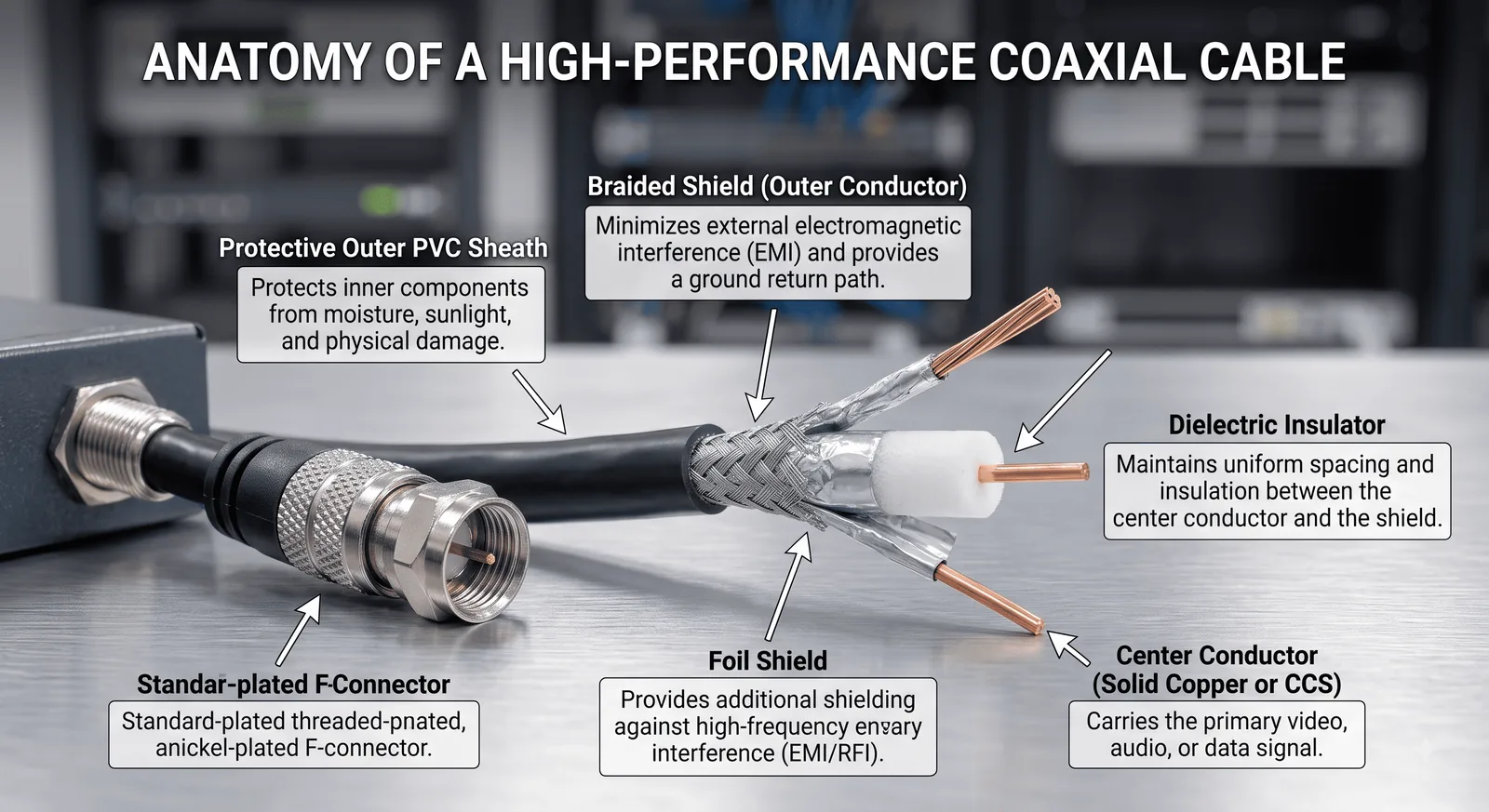
The four parts that make the medium work
Solid copper or copper-clad steel carries the primary electrical signal down the cable.
A precisely sized insulating layer holds the conductor in the middle and establishes the cable impedance.
The outer conductor completes the circuit while rejecting electromagnetic and radio-frequency interference.
The sheath protects the assembly; the fitted F-type or BNC connector must preserve the same geometry.
Where it is used
The cable name is a family, not one universal specification. Pick the construction, connector and equipment for the actual link.
The common 75-ohm cable between a provider drop, splitter, modem and television equipment.
Coax remains useful where a durable, shielded point-to-point video path is needed.
50-ohm families connect antennas, radios, test equipment and other RF hardware.
In cybersecurity
The shield limits accidental radiation, but coax is still a physical bearer of the traffic. Protect the route, connectors and shared plant just as carefully as the devices at either end.
An exposed run can be split or coupled. Restrict access to risers, cabinets, splitters and demarcation points.
Loose or poorly fitted connectors let interference in and signal energy out, degrading service and exposing faults.
Cable access networks share upstream plant. Encryption and provider-side isolation remain essential.
Mixing 50-ohm and 75-ohm parts creates reflections and loss that can look like an attack or outage.
Bond shields according to the installation standard to reduce shock, surge and ground-loop hazards.
Unexpected splitters, adapters or fresh terminations are worth investigating during a physical audit.