UTP Cable
noise cancelled by twistingUnshielded twisted-pair cable carries Ethernet over four balanced copper pairs. Each pair is twisted at a different rate, so interference reaches both conductors similarly and the receiver can cancel it as common-mode noise.
UTP succeeds through balance, twist geometry and correct termination—not through a metal shield. Preserve those three qualities all the way into the jack.
Anatomy of the cable
Read the supplied diagram first, then follow the four layers below from the signal path out to the protective jacket and termination.
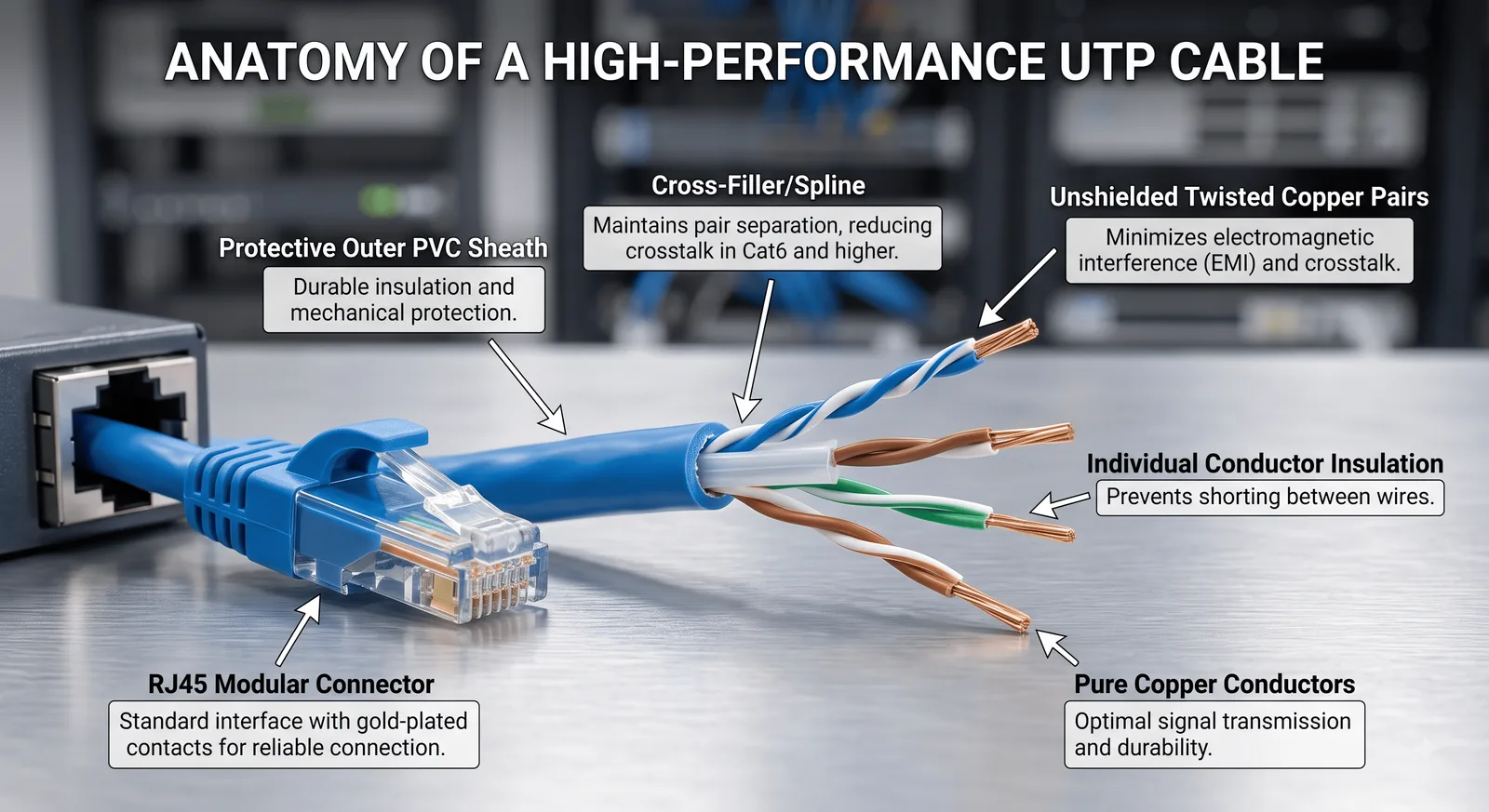
The four parts that make the medium work
Solid conductors suit permanent links; stranded conductors improve flexibility in patch leads.
Each colour-coded pair has its own twist rate to control crosstalk and reject external noise.
Higher-category cables may use a spline to keep pairs apart and preserve performance.
The jacket protects the pairs and indicates ratings such as riser, plenum, indoor or outdoor use.
Where it is used
The cable name is a family, not one universal specification. Pick the construction, connector and equipment for the actual link.
Cat5e, Cat6 and Cat6A links connect outlets to access switches in homes and offices.
The same pairs can deliver data and DC power to phones, cameras and wireless access points.
Short stranded cables connect endpoints and patch panels while tolerating regular movement.
In cybersecurity
UTP is inexpensive and accessible, so the strongest control is often physical ownership of every outlet and cable route. Treat an active wall port as a path into the network.
Unused live ports invite unknown devices. Disable them or enforce 802.1X and port security.
Keep data cable away from motors, fluorescent ballasts and power conductors to avoid intermittent faults.
Excessive untwisting at a jack increases crosstalk. Keep the original twists as close to the contacts as possible.
An accessible run can be bridged or replaced. Secure closets, trays, ceilings and patch fields.
Use compliant cable and terminations; bundled high-power PoE links must meet temperature and current limits.
Wiremap alone does not prove category performance. Certify important permanent links.