ST Connector
legacy fiber with a twist lockST uses a round metal body, a 2.5 mm ferrule and bayonet coupling. Push, twist and lock made it popular in early fiber LANs, although denser LC and SC systems have largely replaced it.
ST remains serviceable in existing plant, but its simplex format and low density make it more common in maintenance than in new datacentre designs.
Anatomy of the connector
Use the supplied plate to identify the connector, then check the four details below before selecting, terminating or mating it.
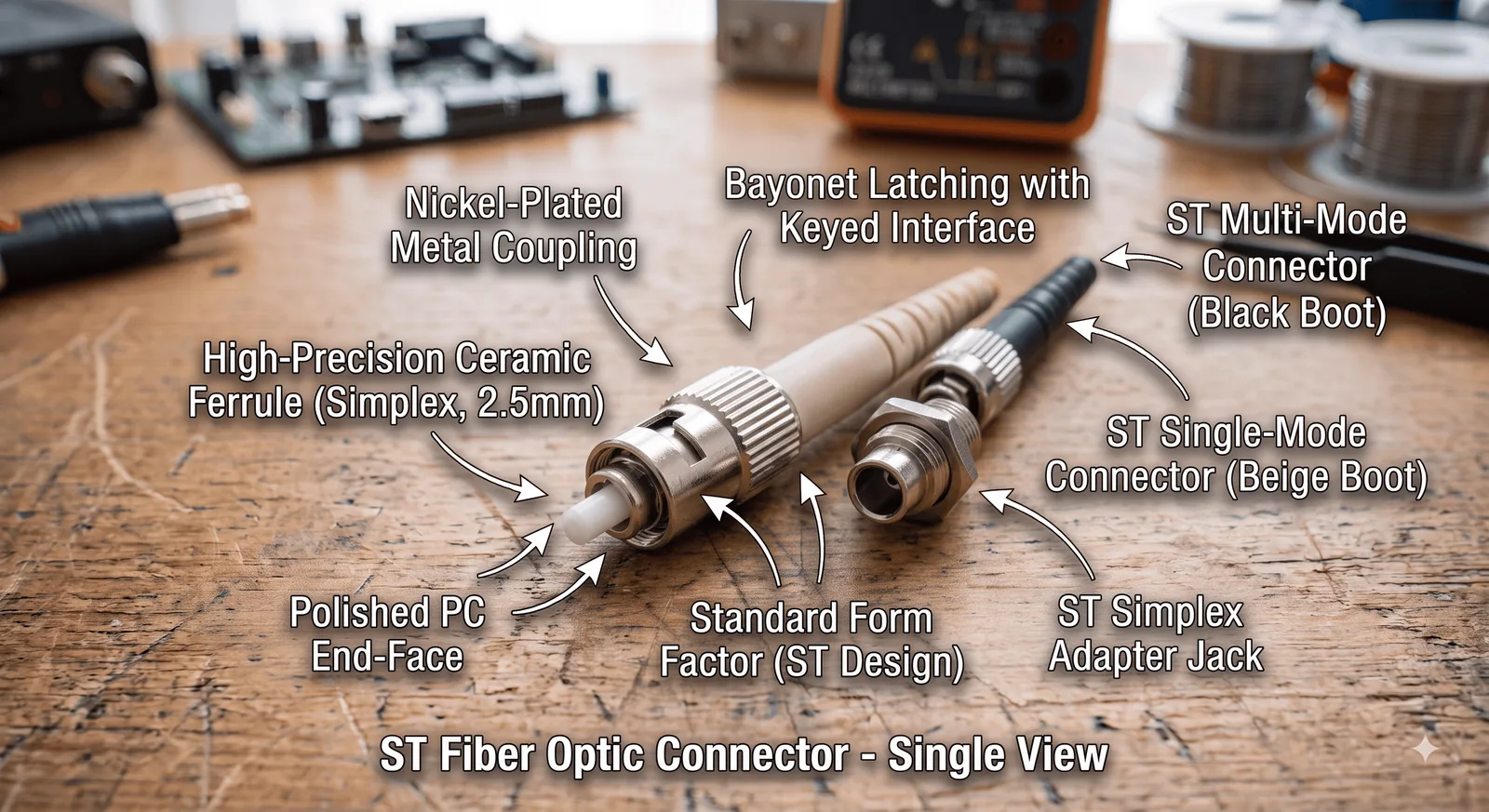
Four details to check before connection
The ferrule centres one polished fiber end.
Spring pressure keeps the paired end faces in contact inside the adapter.
Slots engage adapter posts and lock with a short twist.
The boot limits bending and transfers handling force away from the fiber.
Where it is used
The connector body is only one part of a link. Cable type, signal, impedance or optical polish must match the equipment on both ends.
Older building backbones and hubs may still present ST ports or patch panels.
Twist-lock handling remains convenient on some optical instruments and trainers.
Established multimode control networks often retain ST during phased upgrades.
In cybersecurity & operations
Legacy does not mean harmless. Document ST cross-connects, keep them clean and plan migrations before obsolete parts become an availability risk.
A partly engaged bayonet can create intermittent optical loss.
Two simplex connectors form a duplex link; label transmit and receive clearly.
Long-idle adapters may contain dust. Inspect both sides before reconnecting.
Hybrid cords ease migration but add connection points, loss and inventory complexity.